

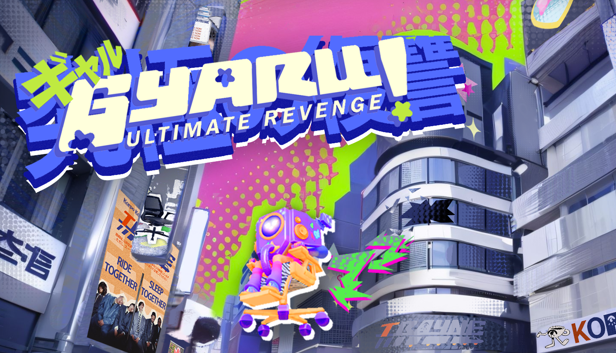
GYARU’S ULTIMATE REVENGE
Genre
Turn-based RPG
Engine
Unreal Engine 4
Team Size
23
Role
Level Designer
Combat System Designer
PROJECT DESCRIPTION
Gyaru’s Ultimate Revenge is a dynamic turn-based RPG created using Unreal Engine 4.
I worked in a multidisciplinary team of 23 people and it was my first time in a team of this size as a designer.
I mainly worked on the combat system and the level design of the city.

INTRODUCTION
This game was the final project of my 3rd year at Isart Digital. We we tasked to create an RPG game based on an Asian city among 3 and featuring a vehicle as the main character.
The team’s choice landed on Kyoto, with a vehicle being an office chair. In the game, you embody a gyaru revening against a society that shaped around conformism and office work. As a level designer, I tried to make people feel they were against the society.
COMBAT SYSTEM
The first thing I worked on was the combat system. We needed a combat system that made players feel like they defy the rules of the society.
The team wanted some physics-based combat, but the objective of the game wasn’t clear enough.
I suggested a system in which you would need to kick out salarymen from offices. They wouldn’t be a threat for you. However, in the meantime, guards would try to kick you out of the building.
We adopted this idea and added to it a percentage system similar to Super Smash Bros games. The more characers collides, the faster they will move after being pushed.


LEVEL DESIGN – CONCEPT
Besides the combat system, my main role on the project was the level design of the city.
Our first task was to make a first concept of the map, on a 2D plan. After making researches on the city and the areas that would be interesting to explore, we came up with a first concept for the map, featuring 3 areas.
We decided rather quickly to cut half of the second area and rework it for metrics and navigation purposes.
We then started the first blockout of areas 1 & 2.
With the art team, we selected the landmarks we wanted to add: Kyoto Tower and Kyoto train station were great choices, as they are easily recognizable from afar.
LEVEL DESIGN – BLOCKOUT & POLISH
I mainly worked on areas 1 & 2, respectively Yamashina Ku, a suburb of Kyoto and Gion, the traditional district. Area 1 was serving as a tutorial, so I needed to make sure players would have a safe play space to learn how to control the vehicle.
One of the main issues we encountered was about verticality. We only added few verticality changes in the landscape as it was causing issues with the character controller. We mostly use verticality by letting players reach building roofs thanks to vertical ramps.
The third area, Gion was reduced in size to avoid more work for the art team. We simplified it as a section of the second area. It still offers what was intended but in a smaller space.


POST MORTEM
This project was the first time I experienced the full process of creating a level. The choice of making an small open world was a high challenge but we managed to make it fun to explore. Making the navigation clear while encouraging players to explore was not easy, but I do think we reached a good spot. I’m proud of the work of the exploration team I was part of, and of the project overall.
What I learned from this project:
– Designing an open area is way harder than a linear level
– Sometimes, making your guidance system too obvious is fine
– Letting players explore is risky, but necessary to make an open world fun to navigate through
– Changing the objective in a combat system can add a lot more depth to it
DOCUMENTS
Gyaru’s Ultimate Revenge
Level Design Document
Walkthrough